Cubric Vision - Models

Models

Browse and install image and video models from the Model Library, understand what each one supports, and see where they show up in the app.

A "model" in Cubric is more than a safetensors file. Each model ships with structural context describing the operations it can run, so the UI only exposes what the model can actually do.

The Model Library

Open the Model Library from the top navigation on the Projects screen. It is a full-page grid split into Installed and Available, each further grouped into Image and Video. Filter by media, by size tier, or by search; click any card to open its detail panel.

Cubric Vision Model Library showing available image models (SDXL Realistic, ILL Anime, PONY Mix, Chroma Flash, NVIDIA PiD Upscaler, Boogu Image Edit) and video models (LTX 2.3, Wan 2.2 Smooth, Wan 2.2 5B) with Install buttons, plus Media and Size filters and a search box
The Library grid, filtered by media and size, with a search box. Install a pack and its files fetch automatically.

Selecting a card opens a detail panel with the model's preview, description, a memory-need readout for your GPU, and its operations. Video models play fullscreen previews.

Cubric Vision Model Library with the Boogu Image Edit detail panel open, showing its preview image, description, memory need for the current GPU, and an Uninstall button
The per-model detail panel: preview, description, memory need, and per-operation controls.

Size tiers and memory

Each model carries a size tier — Low, Balanced, or High — shown as a badge. Hover the tier to see a VRAM and system-RAM table with your own GPU row highlighted, so you can tell before installing whether a model fits your machine. Some models ship the same base at more than one tier as separate cards.

Installing models

Installing several models at once queues them one at a time. Each waiting model shows a cancellable Queued state and starts on its own when the one ahead finishes. An interrupted download — a dropped connection or quitting mid-install — resumes from what it already had rather than restarting.

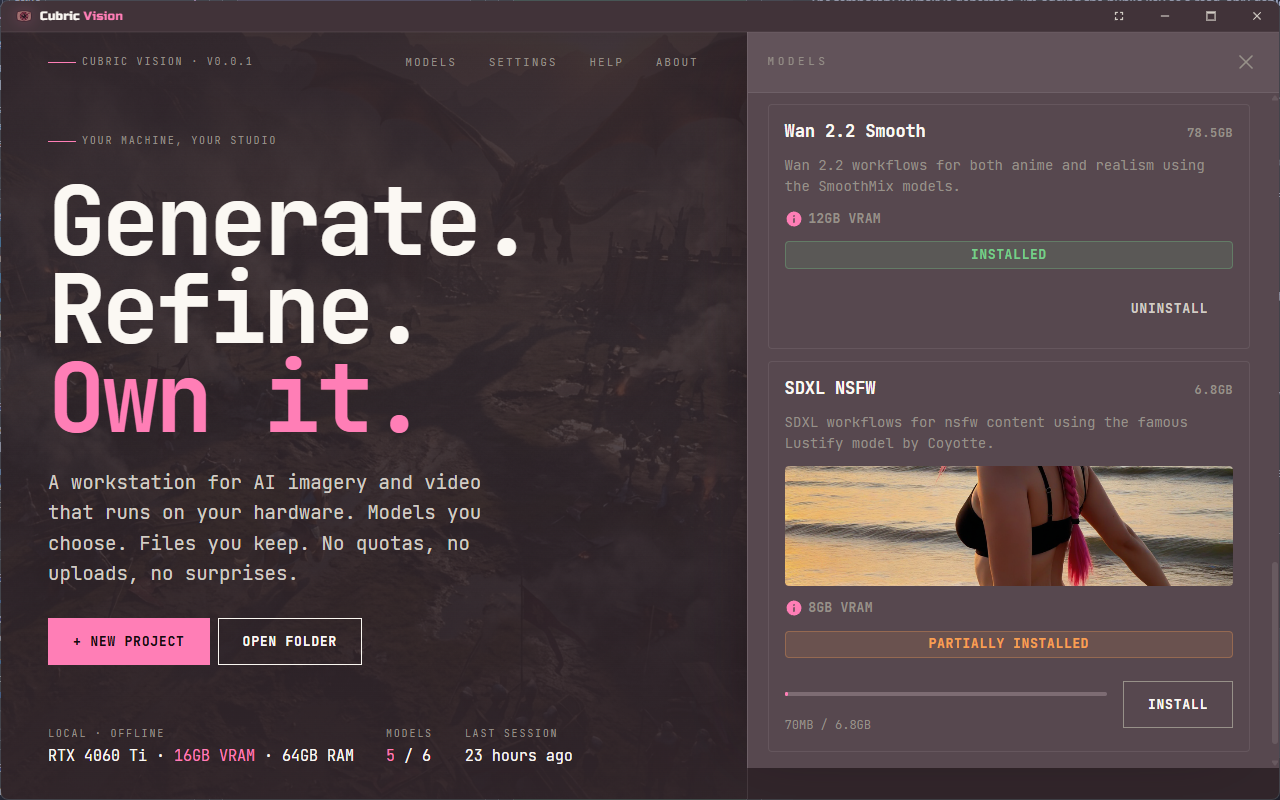
Cubric Vision Models panel showing a partially installed model with missing required files
Partial install states make missing model files visible before you try to run an operation.

A model can show as partially installed when it shares required files with another installed model. It reads as 98% ON DISK beside the Install and Installed labels, rather than as a filling bar — a moving bar in the Model Library means one thing only: something is downloading this second. Installing it later only downloads what is missing, and Cubric Vision enables each operation once the files that operation needs are present.

Most model files have a second download route. If the usual host is blocked — an ISP filter, a school or office network, antivirus web protection — the download retries the same file from Hugging Face automatically and keeps whatever is already on disk. A handful of files still have a single route: the three small preview decoders and a few of the largest model files, served straight from the host that publishes them. If both routes fail you get an explanation rather than a bare error code.

A stall no longer throws the download away: a router blip on a 25GB model retries on its own and picks up where it left off. It still stops promptly and tells you what to do when the network is genuinely blocking the connection.

Uninstalling

Uninstalling a model keeps files another installed model still needs. Since 1.4 it also clears out weights that no installed model needs any more — files that used to be left behind owned by nothing, invisible in the app because a model you do not have installed offers no Uninstall button. The confirmation now counts only files that were actually there and actually deleted.

This works on a cloud Pod's storage volume too, where it matters more: that volume outlives the Pod and you pay for its size every month.

Per-operation installs

Multi-capability models let you choose which operations to download. For example, Wan 2.2 does both text-to-video and image-to-video; you can toggle each one in the detail panel, and the shared parts (VAE, text encoder) download only once. Only installed operations appear in the Prompt Box. Where a model ships weights tuned to different GPUs, Cubric installs only the weight matching your hardware. Image models are unchanged — they install as one unit.

Operations by media type

Which operations a model exposes depends on the model. These are the common ones.

Image models

Image operations are documented in Image Tools:

  • Text to Image (T2I). Base generation from a prompt.
  • Image to Image (I2I). Reshape an input image; the Denoise slider controls how much it changes.
  • Control. Copy the structure of a reference image and paint your prompt into that shape. See Control below.
  • Edit. Instruction editing — change only what you describe. Mask first for a localised edit at full resolution.
  • Detail. Faces, hands, and masked region refinement.
  • Inpaint. Regenerate a masked area, or erase what is under the mask by leaving the prompt empty. See Inpaint.
  • Upscale. Raise resolution, with each model's native upscale.

Video models

Video operations are documented in Video Tools:

  • Text to Video (T2V). Base generation from a prompt. On LTX 2.3, MiniMax H3, and Wan 2.2 5B.
  • Image to Video (I2V). Animate a still image — as the first frame, the last frame, or both. See Prompt Box.
  • Reference to Video. MiniMax H3 Reference only: generate from references rather than from a frame.
  • Audio. LTX 2.3 and both MiniMax H3 models generate a synchronized audio track with the picture.

Model reference

The version tag on a model is the release it shipped in. Size is the model's tier badge in the Library.

ModelKindSizeOperations
FLUX.2 Klein (1.3)PhotoLowT2I, I2I, Control, Edit, Inpaint, Detail, Upscale
SDXL RealisticPhotoLowT2I, I2I, Control, Detail, Upscale
SDXL NSFWPhotoLowT2I, I2I, Control, Detail, Upscale
ILL Anime BeautyAnimeLowT2I, I2I, Control, Detail, Upscale
ILL AnimeAnimeLowT2I, I2I, Control, Detail, Upscale
PONY MixStylizedLowT2I, I2I, Control, Detail, Upscale
Chroma Flash (1.1)Photo (NSFW)BalancedT2I, I2I, Control, Detail, Upscale
Chroma Hyper (1.1)Photo (NSFW)LowT2I, I2I, Control, Detail, Upscale
Krea 2 (1.1)PhotoBalancedT2I, I2I, Control, Edit, Detail, Upscale
Krea 2 NSFW (1.1)Photo (NSFW)BalancedT2I, I2I, Control, Edit, Detail, Upscale
Qwen Image Edit (1.1)EditBalancedEdit (up to 3 references), Control
Boogu Image Edit (1.1)EditHigh & BalancedEdit
NVIDIA PiD Upscaler (1.1)UpscaleLowGenerative 4x upscale
Wan 2.2 SmoothVideoBalancedI2V
Wan 2.2 5B (1.1)VideoLowT2V, I2V
LTX 2.3 (1.1)Video (with sound)High & BalancedT2V, I2V
MiniMax H3 (1.4)Video (with sound)BalancedT2V, I2V
MiniMax H3 Reference (1.4)Video (with sound)BalancedReference to Video

Only FLUX.2 Klein offers Inpaint. Only Krea 2, FLUX.2 Klein, Qwen Image Edit, and Boogu Image Edit take a mask on Edit.

Control — copy the structure of an image

Control takes a picture, reads the structure out of it, and paints your prompt into that shape. The input is a skeleton: none of its colour, style, or identity comes across.

A Control Type picker chooses which structure:

  • Depth. Volume and framing — the result sits at the same distance in the same space.
  • Pose. Body skeleton only — limbs, stance, head angle. Build and framing stay free.
  • Scribble. Loose outlines — the shapes are kept, the detail inside them is not.
  • Canny. Hard edges — the most literal; the result traces the original closely.

A model only offers the types its graph can actually run, and the picker is hidden when there is only one:

ModelControl types
SDXL Realistic, SDXL NSFW, ILL Anime Beauty, ILL Anime, PONY MixDepth, Pose, Scribble, Canny
Qwen Image EditDepth, Pose
Krea 2, Krea 2 NSFW, FLUX.2 Klein, Chroma Flash, Chroma HyperDepth only — no picker

Describe the subject and the scene, not the pose. Words spent on what the control map already gives you are words not spent on the subject.

Control replaces the old Depth operation everywhere. Krea 2 and FLUX.2 Klein still do depth — they do it under the new name, with no picker to choose from.

Control Strength

Krea 2, FLUX.2 Klein, Chroma, and the SDXL family carry a Control Strength slider for how hard the control map pulls. At full strength the composition is locked to the source; easing it off lets the model reinterpret the framing while keeping the pose. Qwen Image Edit has no strength control.

Models that ask you to accept a licence

A few model licences require Cubric to show you the restrictions and record that you accepted them before you receive the weights. MiniMax H3 is the first one shipped this way.

You see the terms before the download starts, and where the model is not licensed in your region, a link to request your own authorization from the licensor. The licence and a way to report misuse stay reachable from the model's panel afterwards. Every other model installs exactly as before, with no extra step.

FLUX.2 Klein

FLUX.2 Klein is the fastest image model in Cubric Vision. It covers the full set in one model: generate from text, reshape an existing image, copy the structure of a reference with Control, edit with up to three reference images, inpaint, clean up detail, and upscale. It is the only model that offers Inpaint. Eight style looks are available on every one of those operations, not just the generative ones.

Quality is modest next to Krea 2. Reach for Klein when you want an answer now, and for Krea 2 when you want the finished piece. It is a Low tier model, so it runs where the larger models will not.

Control takes a second image

Klein's Control operation accepts more than one image, and uses both when you give it two:

  • Image 1 supplies the pose — the structure being copied.
  • Image 2 supplies who is in it — the subject placed into that pose.

So you can put your own character into a pose you found without describing either of them. Krea 2 does the same with two images; SDXL and Chroma take exactly one. Control and Edit take their output shape from the input image, so the ratio picker is hidden on those two operations.

Klein's only control type is depth, so it shows no Control Type picker. It also bites softer than Krea 2 on Control Strength, so it wants a lower setting for the same effect.

New models in 1.4

  • MiniMax H3. A video model that generates the picture and synchronized stereo audio in a single pass, so the sound belongs to the scene because it was made with it. Text to Video and Image to Video, with first-frame, last-frame, or both. Resolutions run up to 4K, but the sizes above its native canvas are final-render territory rather than somewhere to iterate: twice the pixels costs a little over three times the time. It is a big model — 50GB of weights, a slow generator, and a 12GB graphics card at the minimum — and it asks you to accept its licence before it downloads.
  • MiniMax H3 Reference. The same character, place, or voice in every clip, with no training. It works from references rather than a first frame: give it a face, a character sheet, a location, a clip whose camera move you want, or a voice, and it generates a new video that keeps them. Up to nine images, three videos, and three audio clips at once. Nothing you give it appears in the output as-is — these are references, not frames, so the model is free to put your character somewhere new. See Prompt Box for how to point at a specific one. It installs alongside MiniMax H3 and shares its text encoder and both VAEs, so it is one extra model file rather than a second full model.

If what you want is one clip, reach for MiniMax H3. If you want the same character, place, or voice across several, reach for MiniMax H3 Reference.

What changed for existing models in 1.4

  • Wan 2.2 Smooth is image-to-video only. Its Text to Video operation is retired — LTX 2.3 does that job better, and Wan's text-to-video weights were a 27GB download that served nothing else. Image to Video is untouched: same model, same speed, same results. Text to video lives on LTX 2.3, MiniMax H3, and Wan 2.2 5B.
  • LTX 2.3's Balanced tier is one file for every card. The two GPU-specific options (RTX 50 Series / RTX 40 & Older) are gone, replaced by a single 20GB file with better detail and sound. If you already have LTX Balanced installed, the new file downloads once and the old one is cleaned up. Text to Video and Image to Video also share one workflow, so which one you get follows from whether you supply a frame.
  • Chroma gains Control and four styles. Both Chroma models can now follow the depth and composition of an input image, and a style rack — B&W Sketch, Lenovo, Brushwork, and Anime — is available on every operation, Detail and Upscale included.
  • Krea 2 and Chroma keep your source dimensions. On Krea 2, every operation except Text to Image and Image to Image follows the input image's shape instead of the ratio picker. On Chroma it applies to Control, Detail, and Upscale.
  • Krea 2 and Chroma styles reach Detail and Upscale. Every operation on these models runs one workflow, so the style you picked stays applied through the finishing passes instead of being dropped by them.
  • Krea 2 Control takes a second image. Image 1 supplies the pose and composition, image 2 supplies who is posed into it — the same pairing FLUX.2 Klein offers.
  • The Qwen Image Edit tier is one setting for the model. Quality / Turbo / Hyper used to be remembered per operation, so switching between Edit and Control changed the tier underneath you.

New models in 1.1

  • Krea 2 and Krea 2 NSFW. A high-quality image model with a distinctive photographic look. Ten built-in styles picked from a strip of preview cards (plus a None card), an in-prompt enhancer, 1K/2K output, a depth-guided Control operation, and an Edit operation that changes only what you ask. One install covers two speeds via a Turbo toggle. Since 1.3 the quality speed produces far more natural images — lighting reads like a photograph, skin and fabric hold texture, backgrounds resolve instead of going soft, and it sticks more literally to your prompt rather than adding flattering details you never asked for. The fast setting is unchanged. Krea 2 NSFW is the uncensored Lustify-Krea variant (int8 weights, fastest on NVIDIA RTX 20-series and newer). See Krea 2 identity edit for how to order reference images.
  • Qwen Image Edit. An instruction image editor that takes up to three reference images at once and excels at combining them — refer to them by number ("place the person from image 2 into the scene from image 1"). Seven built-in styles and a per-run Quality / Turbo / Hyper speed tier. Output keeps the source image's dimensions.
  • Boogu Image Edit. A unified 10B instruction image editor (Apache-2.0). Describe a change and it edits the whole image while preserving the rest, in two separately installed tiers: High (best quality, most VRAM) and Balanced (fast int8 turbo, lower VRAM).
  • Chroma Flash and Chroma Hyper. Flux-family photographic image models with exceptionally realistic skin (NSFW). Flash is the higher-detail tier with matching upscale and detail passes; Hyper is a lighter, low-VRAM sibling (a smaller download) for the same family.
  • LTX 2.3. A video model that generates with synchronized sound — produce an audio track or drive it from your own clip. Text-to-video and image-to-video with first/last-frame guidance, up to 2K and 4K. It is a high-quality model, not a fast one: it generates more slowly than Wan.
  • NVIDIA PiD Upscaler. A generative 4x image upscaler that adds real detail. Pick a look (Flux, SD3, Qwen, or SDXL), an output size (1K/2K/4K), and how much new detail to invent, at any aspect ratio. Reuse the prompt that made the image, or describe it, for the best result.
  • Wan 2.2 5B. A fast low-tier video model (text-to-video and image-to-video) in one compact 720p download, with a 4-step Turbo mode.

Krea 2 identity edit

The Krea 2 and Krea 2 NSFW Edit operation can take two reference images. How you order them changes the result, and there is one case the model cannot do in a single pass.

Rebuilt in 1.3

The edit path now runs on the newer Krea 2 edit engine, and your reference image is fitted to the shape of the picture you are making. Asking for a new setting gives you a new setting instead of quietly keeping pieces of the original background, restaging someone into a new pose, outfit, or scene lands closer to what you asked for, likeness is better, and a reference whose shape does not match your output no longer comes out stretched or soft.

The more of your reference frame the character fills, the better the likeness. Crop your reference to the person before using it.

Reference order: scene first, subject second

The two reference images are not interchangeable:

  • Image 1 is the scene.
  • Image 2 is the subject — the person whose identity you want to keep.

This matches the order the identity-edit model was trained on. Putting the person first and describing the scene in prompt text is the off-order configuration: it silently degrades the result — there is no error, just worse output. The reference chips in the Prompt Box are numbered and can be dragged, so set the scene as image 1 and the subject as image 2.

Two people in one edit

Putting two people through a single identity edit loses facial identity for both. This is a documented limitation of the identity-edit model, not a Cubric issue — single-reference edits work well on the same setup.

Workaround: chain single-reference inserts. Place person A, then run a second Edit pass that adds person B from their reference. Each pass stays in the one-scene, one-subject order that works. The cost is two full generations per result.

Caveat: a second edit pass can alter regions outside the intended edit and shift the color grade, so person A's face may drift during pass 2. The manual chain is a workaround, not a guarantee.